
LONG-TAILED MANAKIN
Chiroxiphia linearis (Bonaparte, 1838) IUCN: Least Concern - Decreasing
© Gary P Lowry
ECOLOGICAL ROLE
Understorey frugivore and keeper of the forest's lek tradition
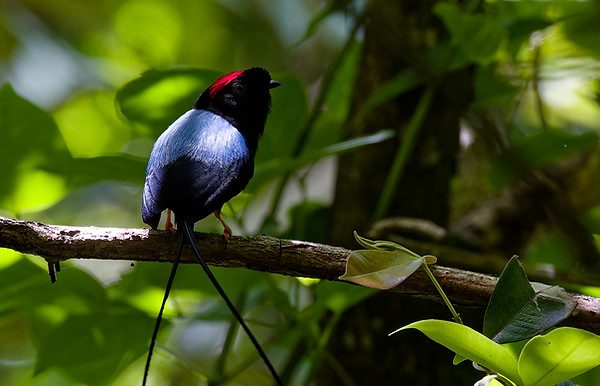
The Long-tailed Manakin is a frugivore of the forest understorey, dispersing seeds of small-fruited understorey plants - Heliconia, Miconia, and related species - that are poorly served by larger frugivores. This dispersal service contributes to the regeneration and structural diversity of the understorey plant community, which in turn provides food and cover resources for a wide range of other species. The manakin is also culturally significant in this region - its elaborate courtship display at traditional lek sites, where males gather year after year in fixed locations, is one of the most distinctive wildlife experiences the Cóbano forest offers and a draw for wildlife tourism in its own right.
© Gary P Lowry
HABITAT & REQUIREMENTS
© Gary P Lowry
Stable forest interior, fixed display sites, connected understorey
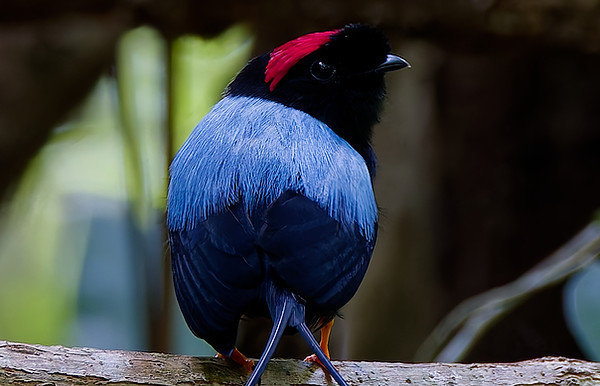
The Long-tailed Manakin's lek system creates a specific and unusual vulnerability. Males return to the same display sites across multiple breeding seasons - meaning habitat disturbance at a particular location does not simply displace an individual but disrupts the social structure of an entire local population built around that site over years. The species avoids open ground and will not cross cleared areas between forest patches, making its distribution across the landscape a sensitive indicator of understorey connectivity - the fine-scale permeability of the forest interior rather than just its overall extent.
WHAT WE LOSE
Plant diversity - and one of the district's most irreplaceable wildlife experiences
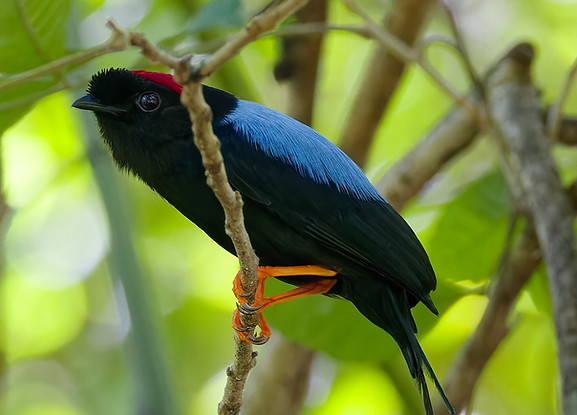
Where manakin populations decline, understorey plant diversity is affected through reduced seed dispersal - a consequence that plays out slowly but compounds across the regeneration cycles of the plant species that depend on them. For wildlife tourism, the Long-tailed Manakin represents something specific and irreplaceable - a species strongly associated with this forest type and this region, whose lek displays are among the most reliably spectacular wildlife encounters available in the district. Its decline from accessible viewing areas would be a tangible loss to the tourism experience that the Cóbano economy is partly built on, and its recovery one of the more visible markers of a forest coming back to life.
© Gary P Lowry
WHAT WE HAVE ALREADY LOST
Four species. Gone within living memory.
Their loss is documented in the historical record of Cabo Blanco and the surrounding peninsula. Each represents not just an absent animal, but a missing ecological function.

Jaguar
Panthera onca (Linnaeus, 1758)
Apex predator. Regulator of prey
populations and trophic structure.

Baird's Tapir
Tapirus bairdii (Gill, 1865)
Central America's largest land mammal. Critical seed disperser.

White-lipped peccary
Tayassu pecari (Link, 1795)
Ecosystem engineer. Forest floor structure and nutrient cycling.
© Smithsonian's National Zoo, CC BY-NC-ND 2.0

Geoffroy´s spider monkey
Ateles geoffroyi (Kuhl, 1820)
Canopy frugivore. Seed disperser for large-fruited forest species.
Source: Timm, R.M. et al. 2009. Mammals of Cabo Blanco. Forest Ecology and Management, 258: 997–1013.
Contributing to:


