
COLLARED PECCARY
Pecari tajacu (Linnaeus, 1758)
IUCN: Least Concern - Stable
ECOLOGICAL ROLE
The animal that physically shapes the forest floor
Collared peccaries are ecosystem engineers - species whose physical presence actively reshapes the environments they inhabit. Moving through forest in social groups, they root through soil, turn leaf litter, break open fallen logs, and create wallows that persist as small wetland habitats used by amphibians, reptiles, and birds long after the herd has moved on. This physical disturbance accelerates nutrient cycling, exposes seed banks, and maintains the structural diversity of the forest floor in ways that benefit a wide range of species. The white-lipped peccary, their larger ecological counterpart and once the dominant engineer of this forest floor, is already locally extinct in Cóbano. The collared peccary is what remains of that functional role.
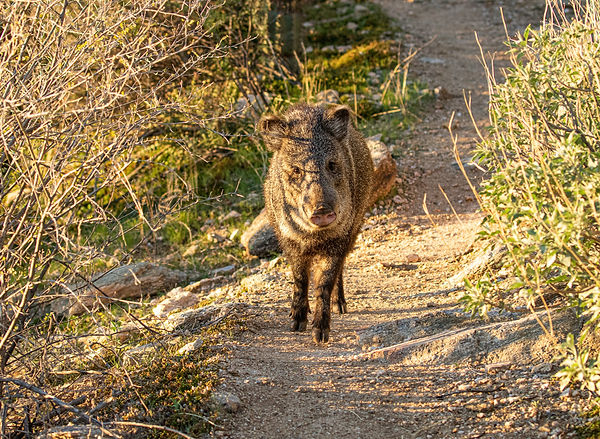
HABITAT & REQUIREMENTS
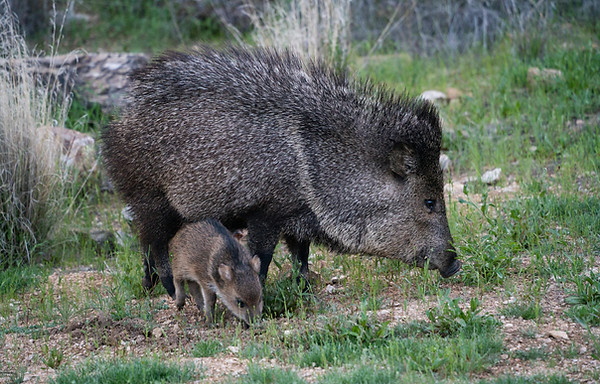
Social movement, water, and room to roam as a herd
Peccaries are highly sensitive to physical barriers in the landscape. Fencing in particular presents a serious obstacle to group movement - a fence that a solitary mammal might navigate around is a barrier to a social herd following an established route. They require access to water, shaded wallowing sites, and sufficient forest area to support a viable social group, making them sensitive to both habitat fragmentation and the degradation of riparian areas. Their movement routes through the agricultural matrix between protected areas are among the most direct tests of whether linear infrastructure is permeable to social mammals.
WHAT WE LOSE
The engineering - and the prey base that protects livestock
Where peccary populations decline, the forest floor engineering they provide is lost - reducing the structural complexity of the understorey, slowing nutrient cycling, and diminishing the small wetland habitats that support amphibians and other moisture-dependent species. For farming communities, declining peccary also signals a degraded prey base for the predator community - a shift that eventually manifests as increased predator pressure on livestock as larger carnivores lose access to wild prey. Their wallows, which in healthy populations provide small but reliable water sources used by multiple species, disappear from the landscape with them.

WHAT WE HAVE ALREADY LOST
Four species. Gone within living memory.
Their loss is documented in the historical record of Cabo Blanco and the surrounding peninsula. Each represents not just an absent animal, but a missing ecological function.

Jaguar
Panthera onca (Linnaeus, 1758)
Apex predator. Regulator of prey
populations and trophic structure.

Baird's Tapir
Tapirus bairdii (Gill, 1865)
Central America's largest land mammal. Critical seed disperser.

White-lipped peccary
Tayassu pecari (Link, 1795)
Ecosystem engineer. Forest floor structure and nutrient cycling.
© Smithsonian's National Zoo, CC BY-NC-ND 2.0

Geoffroy´s spider monkey
Ateles geoffroyi (Kuhl, 1820)
Canopy frugivore. Seed disperser for large-fruited forest species.
Source: Timm, R.M. et al. 2009. Mammals of Cabo Blanco. Forest Ecology and Management, 258: 997–1013.
Contributing to:


