
RUDDY WOODCREEPER
Dendrocincla homochroa (Sclater, 1859) IUCN: Least Concern - Decreasing
ECOLOGICAL ROLE
Regulator of the invertebrates that live in the forest's bark and wood
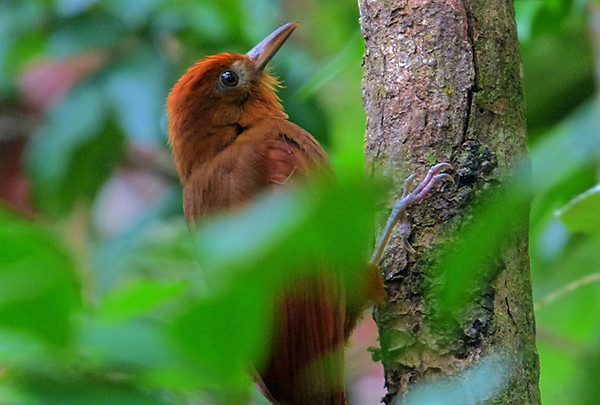
The Ruddy Woodcreeper is an insectivore of the forest understorey, foraging on trunks and branches for the arthropods, small invertebrates, and occasional small lizards that inhabit bark and decaying wood. In doing so it contributes to the regulation of invertebrate populations - particularly wood-boring insects whose unchecked proliferation accelerates tree decay and reduces the structural integrity of the forest. It represents a broader guild of small understorey insectivores that collectively perform this regulatory function across the forest interior, and whose combined presence is one of the clearest indicators of a structurally mature, ecologically diverse forest community.

© Gary P Lowry
HABITAT & REQUIREMENTS
Large mature trees, structural complexity, no open gaps
The woodcreeper's foraging behaviour depends on the presence of large-diameter trees with complex bark structure - conditions that take decades to develop and that characterise mature or advanced secondary forest rather than early regeneration. It breeds in tree cavities, adding a further dependency on structural maturity. It will not cross open ground and avoids degraded secondary growth where tree diameter and bark complexity fall below its requirements, making its distribution a sensitive indicator of forest successional stage and structural quality - measuring not just whether forest is present but whether it has recovered sufficiently to function.
WHAT WE LOSE
Tree health - and the signal that recovery has gone deep enough to matter
Where woodcreeper populations decline, the invertebrate regulation they provide weakens - with consequences for tree health and the pace of forest decay that are relevant both ecologically and practically. Wood-boring insect outbreaks in structurally degraded forest can accelerate the loss of mature trees, reducing the canopy cover and cavity availability that other species depend on. For communities adjacent to forest and for the timber and non-timber forest products those communities use, the presence of a functionally intact insectivore community is part of what keeps the forest productive and structurally sound over time. The woodcreeper's absence from a recovering forest patch is a quiet signal that the recovery, however it looks from above, has not yet reached the structural maturity that makes a forest genuinely resilient.

WHAT WE HAVE ALREADY LOST
Four species. Gone within living memory.
Their loss is documented in the historical record of Cabo Blanco and the surrounding peninsula. Each represents not just an absent animal, but a missing ecological function.

Jaguar
Panthera onca (Linnaeus, 1758)
Apex predator. Regulator of prey
populations and trophic structure.

Baird's Tapir
Tapirus bairdii (Gill, 1865)
Central America's largest land mammal. Critical seed disperser.

White-lipped peccary
Tayassu pecari (Link, 1795)
Ecosystem engineer. Forest floor structure and nutrient cycling.
© Smithsonian's National Zoo, CC BY-NC-ND 2.0

Geoffroy´s spider monkey
Ateles geoffroyi (Kuhl, 1820)
Canopy frugivore. Seed disperser for large-fruited forest species.
Source: Timm, R.M. et al. 2009. Mammals of Cabo Blanco. Forest Ecology and Management, 258: 997–1013.
Contributing to:


