
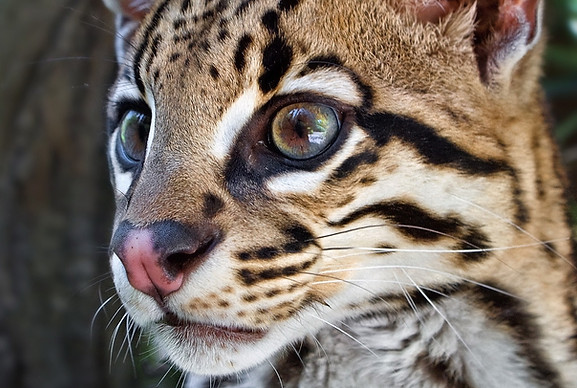
OCELOTE
Leopardus pardalis (Linnaeus, 1758) UICN: Preocupacion Menor - En Descenso
ROL ECOLOGICO
El depredador que mantiene el nivel medio bajo control
El ocelote ocupa el nivel medio de la comunidad de depredadores de Cóbano: caza mamiferos pequeños y medianos, incluidos roedores, pacas pequenas, zarigüeyas y lagartijas, mientras que el mismo forma ocasionalmente parte de la base de presas del puma. Esta posicion intermedia le otorga un papel regulador en multiples niveles tróficos. Al controlar las poblaciones de pequeños mamíferos, los ocelotes limitan el daño que los roedores causan a los bancos de semillas y la regeneración de plantulas, y ayudan a mantener el equilibrio de la comunidad de mesodepredadores, cuyas poblaciones se expanden rapidamente cuando los depredadores de tamano mediano estan ausentes.

HABITAT Y REQUISITOS

Cobertura densa, dosel cerrado, sin terreno abierto
Los ocelotes requieren una densa cobertura forestal para cazar, descansar y anidar. Raramente se detectan a más de una corta distancia del dosel cerrado y no cruzaran terreno abierto voluntariamente. Un parche de bosque que parece continuo pero carece de complejidad estructural, sotobosque denso, troncos caidos, base de presas adecuada, no sostendra ocelotes en densidades significativas. Son sensibles a la perturbación humana y responden a la actividad elevada cambiando a comportamiento nocturno y contrayendo su rango, lo que hace que sus patrones de deteccion sean un indicador confiable de los niveles reales de perturbación en lugar de la disponibilidad nominal de habitat.
LO QUE PERDEMOS
Control de roedores - y un sistema preciso de alerta temprana
Donde la densidad de ocelotes disminuye, las poblaciones de roedores aumentan, con consecuencias directas para la agricultura y el almacenamiento de alimentos en las comunidades que bordean el bosque. La alta densidad de roedores aumenta el riesgo de daño a cultivos y transmisión de enfermedades, mientras que la expansión de los mesodepredadores sin la supresion de la depredacion de nivel medio conduce a incursiones más frecuentes en aves de corral y ganado menor. Los ocelotes son tambien, de forma única entre nuestros mamíferos focales, identificables individualmente por su pelaje, lo que los convierte en la especie a traves de la cual los cambios poblacionales pueden rastrearse con mayor precision a lo largo del tiempo, y la señal de alerta temprana más clara de que la estructura de la comunidad de depredadores esta cambiando
LO QUE YA HEMOS PERDIDO
Cuatro especies. Desaparecidas en la memoria viva.
Su pérdida esta documentada en el registro histórico de Cabo Blanco y la Península circundante. Cada una representa no solo un animal ausente, sino una función ecológica perdida.

Jaguar
Panthera onca (Linnaeus, 1758)
Depredador tope. Regulador de poblaciones de presas y estructura trófica.

Tapir de Baird
Tapirus bairdii (Gill, 1865)
El mamífero terrestre más grande de América Central. Dispersor importante de semillas.

Pecari de Labios Blancos
Tayassu pecari (Link, 1795)
Ingeniero del ecosistema. Estructura del suelo forestal y ciclo de nutrientes.
© Smithsonian's National Zoo, CC BY-NC-ND 2.0

Mono Araña de Geoffroy
Ateles geoffroyi (Kuhl, 1820)
Frugívoro del dosel. Dispersor de semillas de especies forestales de frutos grandes.
Fuente: Timm, R.M. et al. 2009. Mammals of Cabo Blanco. Forest Ecology and Management, 258: 997–1013.
Contribuyendo a:


